
How Klaveness is building its position in Japan, two years on
Trading Efficiency in Practice
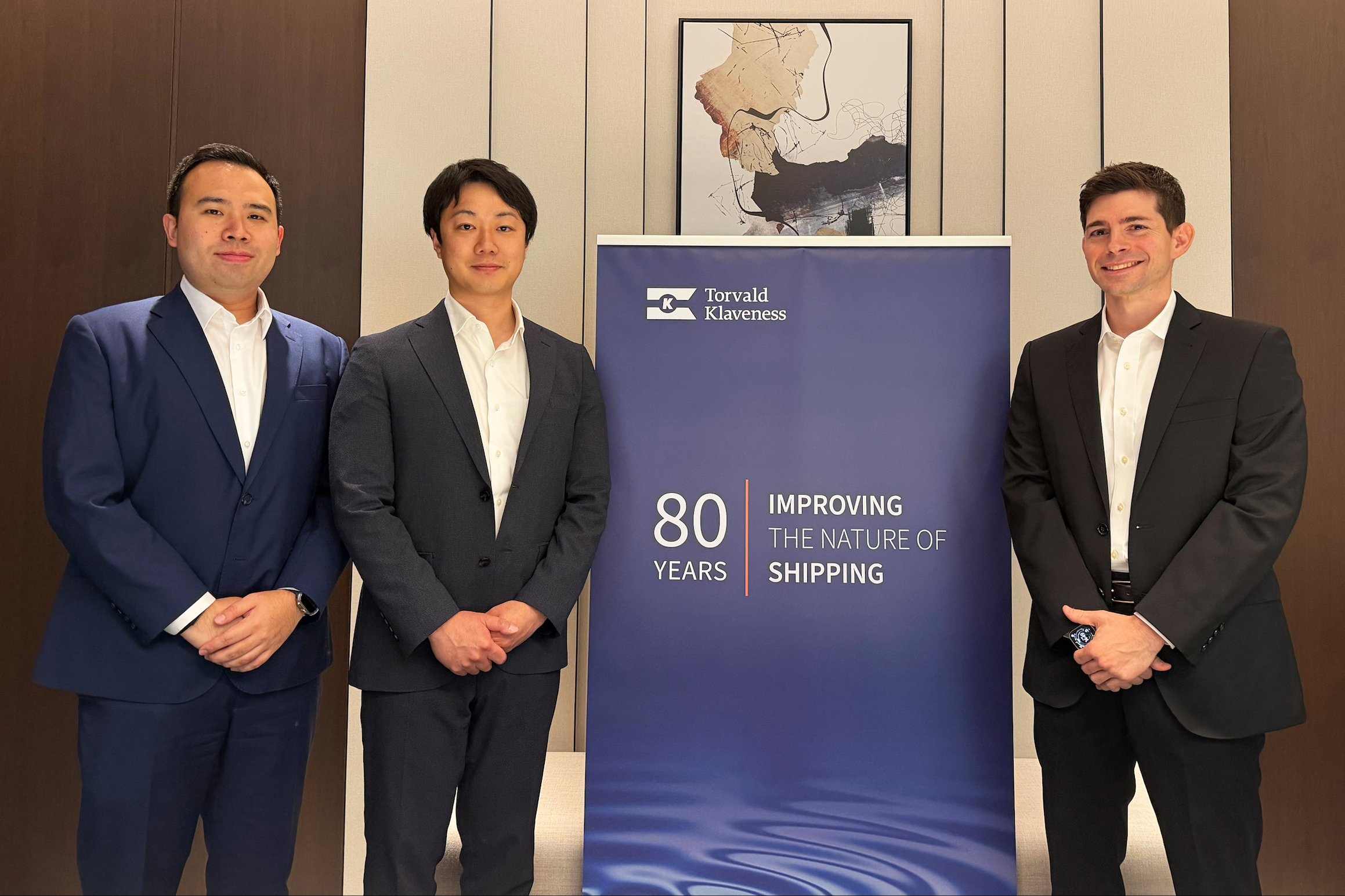
Image (left to right): Klaveness Japan KK Team - Haruki Chua, General Manager - Junji Aratani Chartering Manager - Francisco Gomez, Head of Baumarine
As Klaveness Dry Bulk marked two years in Japan in April 2026, the Tokyo office has moved from establishing a presence to building a role in a highly structured and relationship-driven market. Their progress reflects a deliberate focus on ‘Trading Efficiency’, the Klaveness approach to helping customers make better decisions across the maritime value chain.
In a catch up with Chartering Manager Junji Aratani, he explains how for the team in Japan that role is defined less by competing on freight alone, and more by helping customers navigate choices before, during, and after a fixture.
An evolving market
As one of the first cargo segments to become more international, grain saw Japanese trading houses among the first to engage more actively with international shipowners.
“The grain business has evolved beyond securing freight at the lowest price,” Junji explains. “Cargo structures, vessel selection, timing, and execution all influence the final outcome. Grain cargoes involve a lot of discussion and decision points, and that creates opportunities to support customers more closely.”
This is where Klaveness sees the opportunity to put Trading Efficiency to work. By combining market insight with execution expertise, the focus shifts from freight procurement alone to helping customers make better commercial decisions throughout the process.
Coal, by contrast, has traditionally been served through established domestic networks and long-standing commercial arrangements. But as parts of the market begin to open up, similar opportunities are emerging across a wider range of cargoes.
Trading efficiency in action
Junji points to a recent case involving a Japanese trading house sourcing corn from the US. Faced with a choice between securing freight independently under an FOB purchase or accepting a CFR offer from a different seller, the customer wanted a rapid view of freight rate. “The customer needed to understand whether the freight element was competitive,” Junji says. “They asked us to assess it and see if we could offer an alternative.”
Drawing on market insight and expertise, Klaveness provided a competitive freight solution and secured the business. But, as Junji emphasizes, the real value was not limited to the fixture itself. “The question is not only how you fix the cargo, but how you execute it.”
Execution, in this case, means working with the customer on laycan planning, narrowing arrival windows, and selecting the most suitable vessel for their needs.
“Even if the cargo is nominally Panamax, the customer may prefer a larger vessel such as a Kamsarmax,” Junji explains. “If we can combine the customer’s requirements with market opportunities, we look for solutions that improve the overall outcome.”
These are often small decisions in isolation, but together they influence cost, timing, and reliability. By staying involved beyond the fixture, Klaveness aims to reduce inefficiencies that typically arise between commercial decisions and operational execution.
Becoming a trusted partner
This way of working is becoming central to how Klaveness Dry Bulk operates globally, with particular emphasis in Japan. “The difference is that we spend more time both before and after the fixture,” Junji says. “We share market views, discuss options, and stay closely engaged throughout execution.”
In Japan, that consistency matters. Trust is built over time through frequent interaction and a clear commitment to follow through. Face-to-face dialogue remains an important part of that process.
Michael Jørgensen, Head of Klaveness Dry Bulk concludes. “While many other international operators visit Japan with a core focus on vessel owners, our approach has been to that of serving both sides of the deal in optimizing the overall freight solutions for our industrial charterers, and to provide the best earning management models for the ship owners with a local presence.”
As Klaveness enters its third year in Japan, the focus will remain on deepening its presence and continuing to support customers with insight-driven decision-making and strong execution.
About Torvald Klaveness
Torvald Klaveness is a pioneering shipping company with a vision to improve the nature of shipping and a mission to make seaborne supply chains more resilient, decarbonized and cost-effective.
The company consists of a holding structure and three operating companies. Klaveness Holding executes active ownership of the existing portfolio of companies, drives new strategic investments, and manages a portfolio of liquid financial investments.
Klaveness Combination Carriers actively participates in the transition to low-carbon shipping with its unique combination carrier concept. Klaveness Dry Bulk is a leading operator servicing the global dry bulk industry and manages the world’s largest Panamax pool. Klaveness Digital is responsible for the development and commercialization of digital services, including CargoValue, one of the world’s leading platforms for managing seaborne supply chains, and the portfolio of freight decision support software. It also serves as a hub for innovation to test, validate, and commercialize new ideas.
With 80 years of experience, Klaveness operates approximately 75 vessels through offices in Oslo, Singapore, Manila, Dubai and Tokyo, employing around 155 people.
More information about our company and our activities can be found at www.klaveness.com